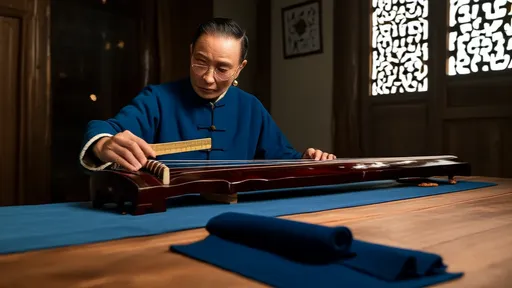
The ancient art of guqin, a seven-stringed zither with over 3,000 years of history, demands meticulous care and attention. Among its many maintenance rituals, the process of restringing stands out as both a technical challenge and a spiritual practice. Unlike modern instruments, the guqin relies on silk strings, which require a delicate touch and deep understanding of the instrument's soul.
Restringing a guqin begins long before the actual process. Seasoned players often speak of the importance of timing, waiting for the right moment when the instrument feels ready. The silk strings themselves are living entities, responding to humidity, temperature, and the player's energy. Before removing old strings, one must carefully document their tension and position, as these subtle details contribute to the guqin's unique voice.
The removal of aged strings becomes a ceremony in itself. Each string must be unwound with reverence, its years of service acknowledged. Traditional practitioners often keep the old strings for months before properly disposing of them, as abrupt removal can shock the instrument's wooden body. The hollowed-out soundboard, usually made of tong wood, needs time to adjust to the absence of tension before accepting new strings.
Selecting replacement strings involves more than purchasing the correct gauge. Master string-makers still produce silk strings using methods unchanged for centuries, with each set carrying its own characteristics. The color of the silk, the tightness of the twist, even the season when the silkworms spun their cocoons - all these factors influence the final sound. Connoisseurs can spend months searching for the perfect set that matches their instrument's personality.
String installation requires both precision and intuition. The process begins at the dragon's gums (longyin), where strings get anchored with special knots that must hold firm yet allow micro-adjustments. As each string gets gradually tensioned, the player must listen for the moment when the string "settles" into the wood. Traditional methods call for leaving new strings slightly flat for several days, allowing them to stretch naturally rather than forcing them to pitch.
The tuning process extends far beyond matching notes to a digital tuner. Silk strings exhibit unique behaviors - they breathe with humidity changes, their harmonics develop over weeks of play, and they require different attack techniques compared to metal strings. Experienced players develop a tuning ritual, often involving specific intervals that test the string's responsiveness across the entire soundboard.
Breaking in new strings becomes a months-long conversation between player and instrument. The initial bright tones will mellow, the sometimes brittle attack will soften, and the strings will gradually reveal their true character. During this period, players often adjust their technique, discovering new phrasing possibilities as the strings mature. Some traditional schools advocate composing new pieces during this break-in period, capturing the strings' evolving personality in music.
The entire restringing process serves as a reminder of the guqin's living nature. In an age of synthetic materials and instant gratification, the silk string ritual preserves an ancient dialogue between natural materials and human artistry. Each time a player restrings their guqin, they don't just maintain an instrument - they renew a covenant with centuries of tradition and awaken new possibilities for expression.
Modern players face unique challenges in this ancient practice. Climate-controlled environments, while protecting the wood, can hinder the natural conditioning of silk strings. The scarcity of master string-makers has led some to attempt making their own strings, rediscovering forgotten aspects of the craft. Meanwhile, scholarly research continues to uncover historical stringing methods that challenge contemporary assumptions.
The spiritual dimension of restringing remains as vital as the technical aspects. Many players observe periods of meditation before and after the process, aligning their energy with the instrument. Some traditions include burning specific incense or choosing auspicious dates according to lunar calendars. These practices underscore the guqin's role not just as a musical instrument, but as a medium for philosophical exploration and self-cultivation.
As the last string settles into its proper tension and the first notes ring out, the player begins a new chapter in their relationship with the instrument. The slightly unstable pitch, the fresh silk's faint scent, the unfamiliar resistance under the fingers - all these sensations mark the beginning of another journey. In this way, the guqin continues its endless cycle of renewal, connecting present to past through each carefully wound strand of silk.
By /Aug 13, 2025

By /Aug 13, 2025
By /Aug 13, 2025

By /Aug 13, 2025
By /Aug 13, 2025

By /Aug 13, 2025

By /Aug 13, 2025

By /Aug 13, 2025
By /Aug 13, 2025

By /Aug 13, 2025

By /Aug 13, 2025

By /Aug 13, 2025

By /Aug 13, 2025

By /Aug 13, 2025

By /Aug 13, 2025

By /Aug 13, 2025

By /Aug 13, 2025
By /Aug 13, 2025

By /Aug 13, 2025

By /Aug 13, 2025
